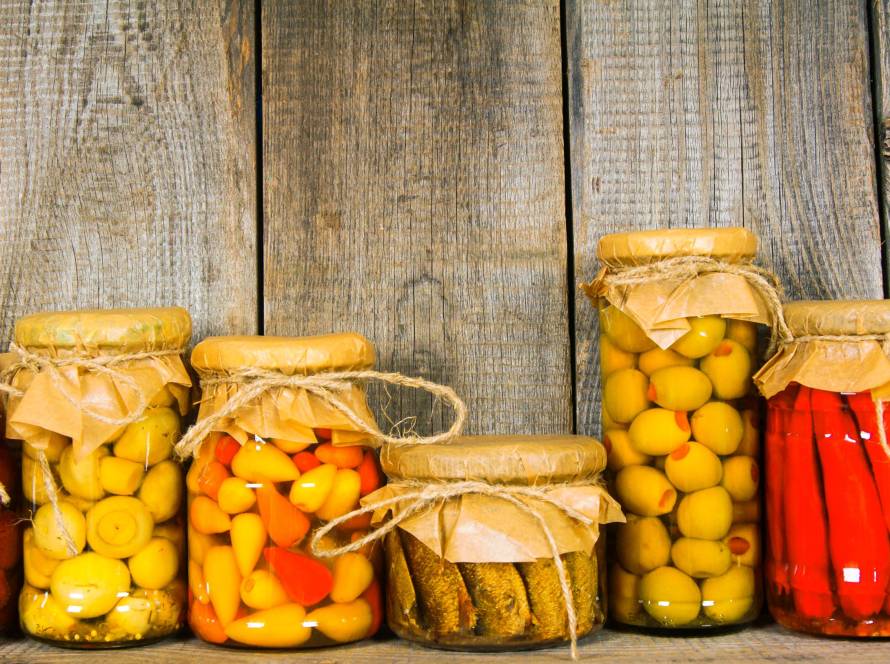
Industrial pickle production consists of ten core stages: raw material intake and quality control, washing, sizing/calibration, brine preparation, controlled fermentation, recipe-based flavoring, filling, brine dosing and capping, pasteurization, and final inspection and packaging. At every stage, temperature, salt content, and acidity levels are recorded — ensuring the same texture and flavor across every batch.
In this article, we walk through the process step by step, compare it with home pickling, and explain how private label production works.
How Are Pickles Made? The 10 Stages
- Raw material intake and input control
The process begins in the field. When harvested vegetables arrive at the facility, they’re checked for size, firmness, color, ripeness, and visual defect rate. The decision made at this stage determines qualities that can’t be corrected later: a soft or overripe cucumber will never yield a firm pickle.
This is why harvesting at the right moment is critical. Our guaranteed-purchase producer network across the Aegean and Mediterranean regions ensures we bring product into the facility without missing the harvest window.
- Washing and sorting
Vegetables pass through multi-stage washing lines to remove soil and foreign matter. Sorting happens on the same line: damaged, broken, or off-spec product is removed.
- Calibration (sizing)
Vegetables are grouped by size. This serves two purposes. First, visual consistency: products in the same jar should look alike. Second — and more important — is a technical one: same-sized pieces absorb brine at the same rate. Mixing different sizes in one jar means some pieces under-ferment while others over-ferment and turn soft.
- Brine preparation
Brine is the component that defines a product’s character. Salt concentration, acidity level, and water quality are prepared according to the recipe and verified by measurement in every batch. Salt here does more than season — it firms up texture and suppresses the growth of unwanted microorganisms.
- Controlled fermentation
In salt-brined (fermented) production, vegetables rest in fermentation tanks while lactic acid bacteria do their work. This is where the key difference from home pickling lies: temperature and duration are controlled. Ambient temperature is not allowed to fluctuate with the season; fermentation is monitored, acidity development is measured, and the process is stopped once target values are reached.
Uncontrolled fermentation is the main cause of the foaming, sliminess, and texture breakdown seen in home-pickled jars.
- Recipe and flavoring
The product is formulated according to the target market’s palate expectations. Acid-salt balance, sweetness level, spice, and aroma components are determined at this stage. The same vegetable is produced under different recipes for different markets — a gherkin destined for Germany doesn’t have the same profile as one destined for the Middle East.
- Filling
The product is transferred into packaging. Three main formats are used depending on channel and market:
- Glass jars — retail shelf products, private label brands
- Tin cans — industrial and foodservice use
- Drums — bulk export and further-processing manufacturers
Fill weight and the product-to-brine ratio are continuously monitored on the line.
- Brine dosing and capping
Brine is dosed at target temperature, jar rims are cleaned, and jars are capped under vacuum. Vacuum is the primary barrier preventing air exposure throughout the product’s shelf life, which is why cap seal integrity and vacuum level are measured on the line.
- Pasteurization
The product undergoes heat treatment at a temperature-time combination set according to the recipe and packaging format. The goal is to ensure microbiological safety and stabilize shelf life. Parameters are optimized to preserve texture: under-pasteurization is a safety risk, over-pasteurization means texture loss.
- Final inspection, labeling, and packaging
The product passes through metal detection and visual inspection; fill weight, cap vacuum, and label accuracy are checked. Labeling follows the target market’s regulatory requirements. The product is then cased, palletized, and moved into warehouse storage under a batch number.
Every batch is recorded with which raw material, on which date, and under which recipe it was produced — making it fully traceable. The ability to trace a product back to the field in the event of an issue is one of the most fundamental expectations of export customers.
Home Pickling vs. Industrial Pickle Production
| Criteria | Home pickling | Industrial production |
| Raw material selection | Market purchase, by eye | Input control against spec, calibration |
| Salt and acidity | By recipe, estimated | Measured and recorded per batch |
| Fermentation temperature | Ambient, season-dependent | Controlled and monitored |
| Consistency | Varies jar to jar | Consistent across batches |
| Shelf life | Short, storage-dependent | Stabilized through pasteurization |
| Traceability | None | Full batch-level records |
| Certification | — | BRC, IFS, Halal, Kosher |
This comparison doesn’t mean home pickling is “inferior” — a jar made by hand has its own distinct value. The difference is this: industrial production makes a claim to repeatability. A product sitting on a retailer’s shelf tasting the same twelve months in a row is only possible through a measured process.
Quality and Food Safety in Pickle Production
Pickle production isn’t a low-acid food category — acidity is the product’s core safety barrier. That’s why quality management isn’t just about taste checks; it’s about managing measured parameters.
At Zeytursan, we run our production to BRC and IFS food safety standards, and secure Halal and Kosher certification depending on the market. Quality control operates at four checkpoints: input stage, fermentation monitoring, filling line, and final product.
As a producer exporting to nearly 100 countries, we manage each market’s regulatory, labeling, and certification expectations separately. More details: [Export]
Where Does the Raw Material Come From?
Pickle quality is determined before the vegetable ever reaches the facility. That’s why production planning starts with the harvest calendar.
We work with a guaranteed-purchase producer network across the Aegean and Mediterranean regions. This model provides predictability for both sides: the producer commits to planting knowing their buyer is secured, and we lock in the volume and quality we need within the harvest window.
For a behind-the-scenes look at harvest season: [Harvest season behind the scenes]
How Does Private Label Pickle Manufacturing Work?
Private label means a product sold under a retailer’s or brand’s own label, manufactured by a producer according to that brand’s recipe and packaging specifications. The product leaves the manufacturer’s facility but reaches the shelf under the brand’s identity.
The process generally follows these steps:
- Brief — Target market, product type, packaging format, price positioning, and volume expectations are clarified.
- Formulation — A recipe is developed to match the target palate profile. The same product can be formulated with different acidity and spice balances for different markets.
- Sample — A sample batch is produced and sent to the customer.
- Revision and approval — The recipe is adjusted based on feedback; specification, label, and packaging are approved.
- Mass production — Production is scheduled according to the approved specification.
- Shipment — Packaging, documentation, and logistics are completed to the target market’s requirements.
In this model, the manufacturer isn’t a contract producer — it’s a product development partner. Recipe development, packaging compatibility, regulatory documentation, and supply continuity are all part of the process.
If you’d like a quote for private label pickle or sauce production, get in touch with us. Share your target market and product expectations, and our formulation team will begin the sampling process.
What to Look for When Choosing a Pickle Manufacturer
A checklist from the buyer’s side:
- Certification scope — Are food safety standards like BRC and IFS in place, along with Halal and Kosher certification where relevant?
- Traceability — Can batches be traced back to the field?
- Raw material security — Does the producer buy on the spot market, or work with a contracted producer network? This determines supply continuity during disruptions.
- R&D capacity — Can they develop market-specific formulations, or only produce existing recipes?
- Packaging flexibility — Are glass, tin, and drum formats all available?
- Export experience — Do they understand the target market’s regulatory and documentation processes?
At Zeytursan, we’ve been producing in this field since 1983. More on our corporate history and capacity: [About us] · [Turkey’s pickle producer: Zeytursan]
Frequently Asked Questions
How are pickles made in a factory? Production goes through ten stages: raw material intake, washing, calibration, brine preparation, controlled fermentation, flavoring, filling, brine dosing and capping, pasteurization, and final inspection and packaging. Salt, acidity, and temperature values are recorded at every stage.
What’s the difference between industrial and home-made pickles? In industrial production, salt, acidity, and temperature are controlled through measurement and recorded per batch. This ensures consistency across batches and a stable shelf life; in home pickling, these variables depend on ambient conditions.
What certifications are required in pickle production? For export-focused production, BRC and IFS food safety certifications are the baseline expectation. Halal and Kosher certifications are also required depending on the target market.
What is private label? Private label means a product sold under a retailer’s or brand’s own label, manufactured by a producer according to that brand’s recipe and packaging specifications.
In which season is pickle production done? Raw material is harvested and enters fermentation during harvest season. Filling, pasteurization, and shipment continue year-round.
Why is calibration done in pickle production? Same-sized pieces absorb brine at the same rate. Calibration ensures every piece in a jar reaches the same texture and fermentation level.
Why are pickles pasteurized? Pasteurization ensures microbiological safety and stabilizes shelf life. Parameters are set to preserve the product’s texture.
What should be considered when choosing a pickle manufacturer? Certification scope, batch-level traceability, contracted raw material supply, R&D and formulation capacity, packaging variety, and export experience in the target market should all be evaluated.