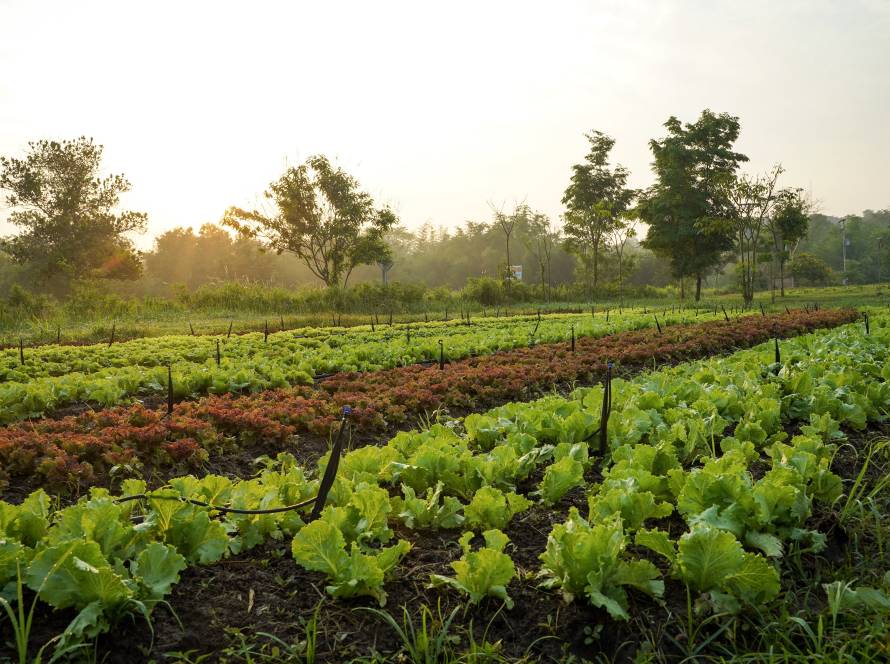
Drip irrigation is a method of watering crops that delivers water directly to the base of each plant through a network of tubes, valves, and emitters, rather than spraying it across an entire field. Water is released slowly and precisely, so it soaks into the root zone instead of evaporating or running off. This makes drip irrigation one of the most water-efficient irrigation methods used in modern agriculture.
Below we explain how a drip system works, what it’s made of, and why it matters for both water use and crop quality.
How Does Drip Irrigation Work?
A drip system moves water through three basic stages: it’s pumped from a source, filtered and pressure-regulated, then released through emitters placed at or near each plant’s root zone.
Unlike sprinkler or flood irrigation, which apply water to the whole surface of a field, drip irrigation targets only the area where the plant actually absorbs moisture. Because the water enters the soil slowly, it has time to soak in rather than pool on the surface or run off between rows.
The Main Parts of a Drip Irrigation System
Water source and pump — Draws water from a well, reservoir, or main line and moves it into the system at a controlled pressure.
Filter — Removes sediment and debris before water reaches the tubing. Emitters have narrow openings, so filtration is essential to prevent clogging.
Pressure regulator — Keeps water pressure within the range the emitters are designed for. Too much pressure causes uneven flow; too little reduces efficiency.
Main and lateral lines — The main line carries water from the source across the field; lateral lines (usually flexible tubing) run along or between crop rows.
Emitters (drippers) — Small devices installed along the lateral lines that release water at a fixed, slow rate directly at the plant’s base.
Timer or controller — Automates when and how long the system runs, often based on soil moisture or a set schedule.
Why Drip Irrigation Saves Water
Three mechanisms explain the water savings:
- Targeted delivery. Water goes to the root zone, not the spaces between plants where it would simply evaporate or feed weeds.
- Low application rate. Water is released slowly enough to be absorbed by the soil, minimizing runoff.
- Reduced evaporation. Because water isn’t sprayed into the air or left standing on the surface, less is lost to evaporation, especially in hot or windy conditions.
Compared to flood or sprinkler irrigation, drip systems typically use significantly less water to deliver the same amount of moisture to the plant.
Drip Irrigation vs. Other Irrigation Methods
| Method | How water is applied | Water efficiency | Best suited for |
|---|---|---|---|
| Drip irrigation | Directly to root zone, slow and steady | High | Row crops, orchards, greenhouse production |
| Sprinkler irrigation | Sprayed over the field surface | Medium | Large open fields, uniform crops |
| Flood irrigation | Water released across the surface to flow by gravity | Low | Flat terrain, low-cost setups |
What Are the Benefits of Drip Irrigation?
- Water efficiency — Less water lost to evaporation and runoff.
- Consistent moisture — Plants receive water steadily rather than in large, infrequent doses.
- Reduced weed growth — Only the root zone is wetted, so the space between rows stays drier.
- Lower disease pressure — Foliage stays dry since water isn’t sprayed onto leaves, reducing conditions that favor fungal disease.
- Compatibility with fertigation — Nutrients can be delivered through the same system as the water, improving precision.
Are There Any Drawbacks?
Drip systems require more upfront setup than a simple sprinkler and need regular maintenance — emitters can clog, and tubing can be damaged by rodents or equipment. Filtration and periodic flushing of the lines are necessary to keep the system working efficiently over time.
Frequently Asked Questions
What is drip irrigation? Drip irrigation is an irrigation method that delivers water slowly and directly to a plant’s root zone through tubing and emitters, rather than spraying or flooding the whole field.
How does drip irrigation save water? It reduces water loss by targeting only the root zone, applying water slowly enough for the soil to absorb it, and minimizing evaporation compared to sprinkler or flood methods.
What are the main components of a drip irrigation system? A water source and pump, a filter, a pressure regulator, main and lateral lines, emitters, and typically a timer or controller.
Is drip irrigation better than sprinkler irrigation? Drip irrigation is generally more water-efficient because it targets the root zone directly, while sprinklers distribute water across the whole field surface, increasing evaporation and runoff.
What crops is drip irrigation best suited for? Row crops, orchards, and greenhouse production benefit most, since each plant’s root zone can be targeted individually.
Does drip irrigation require maintenance? Yes. Filters need regular cleaning, and lines should be flushed periodically to prevent emitters from clogging with sediment.